
Chico Previous Residents by Era
No one source spans the whole history of a Chico house. Start with the Chico era of interest, then choose the keeper that actually holds that record. The Chico recorder's web starting year is not stated in an official source. The Chico library sets are incomplete. Census release rules limit the modern research horizon. The table below keeps those Chico limits visible while showing where an address trail can continue.
| Chico source | Years it covers | Where held | What it shows |
|---|---|---|---|
| Chico recorder index and deeds | Online start not officially stated | Butte Clerk-Recorder | Named parties, instrument dates, legal description, recorded chain |
| Chico city directories | First 1881; documented runs into 1982 | Meriam, Chico Branch, digital collection | Alphabetical names and numerical street occupants, with gaps |
| Chico newspapers | 1851 or 1854 onward, depending collection | Meriam and Butte County Library | Notices, moves, deaths, businesses, and family references |
| Chico vital newspaper index | About 1854-1897 | Oroville Branch and linked indexes | Surname, event, and newspaper pointers |
| Sanborn maps | 1884, 1886, 1890, 1902, 1909, 1921-November 1949 | Library of Congress and Meriam | Footprints, uses, street labels, and neighborhood extent |
| Chico federal census | Released through 1950 under the 72-year rule | Library and archival databases | Household snapshots at ten-year intervals |
| Chico permits | 2012-present | City eTRAKiT or city records staff | Projects, applicants, inspections, and building chronology where shown |
The best starting row depends on the Chico question. Deeds answer ownership transfers. Directories and census records are stronger for past household clues. Sanborns test whether a Chico building and street label existed. The previous residents of a Chico address emerge from the overlap, not from a single search box.
Walking the Chico Previous-Resident Deed Chain
Begin with the current Chico parcel and the named party that the public assessor or parcel record actually displays. Search that Chico person or entity as a grantee in the Butte Recorder self-service index. Open the complete acquisition instrument when the identity matters. The Chico deed gives the grantor, grantee, date, Document ID, and legal description. Then search the seller as an earlier grantee and repeat.
The Chico recorder warns that its index is a catalog and advises spelling variants. A Chico name alone can join two unrelated people. Compare the legal description, APN, book or document identifiers, recording date, and party role at every step. When the online result ends, the Chico counter, public terminal, written request, or staff research route is the correct fallback. The staff-research minimum in the research is 15 minutes at $43.50.
- Record the modern Chico address, APN, visible parcel fields, and retrieval date.
- Identify the likely Chico acquisition deed and obtain the full instrument or its document ID.
- Search the grantor as a prior grantee using Chico spelling and entity-name variants.
- Compare the Chico legal description before accepting the next link in the chain.
- Move to the Recorder counter or request channel when the web index cannot reach the needed era.
- Grantor and grantee
- The grantor transfers the recorded interest; the grantee receives it.
- Chain of title
- The connected sequence of recorded transfers for a parcel or legal description.
- Legal description
- The recorded land identifier, often a lot and block or other formal description, that can outlast a street label.
- Index versus instrument
- The index points to a record; the complete instrument contains the actual recorded terms and description.
The image below is the official Chico deed-index starting point for a backward trail.
Open the Butte Recorder self-service index before ordering a complete document.
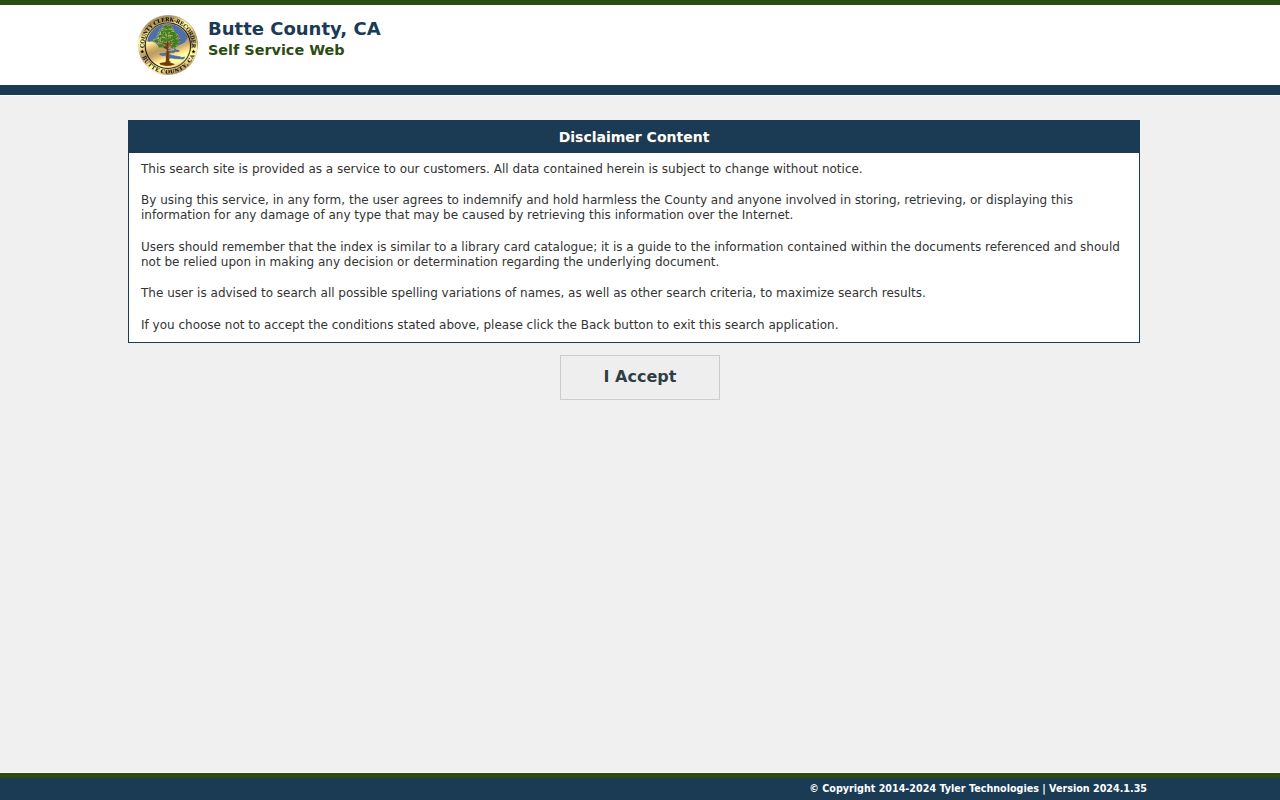
Use the Chico index as a catalog and the underlying deed as the evidence. A current owner record still does not name every person who lived at the Chico address.
Chico Address Records and Legal Descriptions
Chico street numbers are convenient and fragile. A Chico parcel can carry a different number in an older deed, use a historic community name, or sit in a place that was later annexed. A legal description and APN let a researcher test whether an old Chico instrument refers to the same land. Use the map to understand the approximate parcel, then use the recorded description to connect the instrument.
Do not silently promote a Chico assessment record into title proof. The assessor maintains parcel maps, values, descriptions, ownership changes, exemptions, and characteristics. The Treasurer handles tax status. The Recorder proves the recorded instrument. A Chico permit dates work on a structure. Each record has a narrower role.
For an address that crosses an old Chico community label, search spelling variants and consult the Meriam Northeastern California collection. Historic place names can be the missing bridge between a modern Chico street and an older record.
| Modern Chico street number | Useful search input, but it can change or be absent from an older record. |
|---|---|
| Chico APN | Tax-map link that helps connect the parcel systems, but is not a legal description. |
| Lot and block or plat | Recorded geography that can bridge subdivisions and changing street labels. |
| Situs and mailing address | Physical location and delivery destination, which may diverge. |
Seven Chico Address Records in Sanborn Editions
Sanborn fire-insurance maps give a Chico address history a physical check. Chico coverage includes editions from 1884, 1886, 1890, 1902, 1909, and 1921, with a corrected atlas continuing through November 1949. The collection grew from seven sheets in 1884 to 84 sheets in the corrected 1921-49 atlas. A Chico map can show a building footprint, use, street label, and neighborhood extent at the time of the survey.
Sanborn sheets do not name every occupant and do not establish title. Pair a Chico sheet with a directory's numerical street guide, a deed description, or a newspaper notice. The 1902 atlas includes Oakdale and Chapman Town. The 1909 coverage also includes Chico Vecino and Barber. Those labels matter when a search for “Chico” misses an older address.
The Library of Congress Chico Sanborn item is the online route for the corrected atlas. Meriam's local-history holdings provide another collection context. Preserve sheet number, edition, and the old place label with the address note.
Note: A Sanborn footprint dates the built environment; it does not prove who lived in the building.
Reverse Old Chico Addresses in Street Guides
Chico city directories are the practical bridge from an old address to previous residents. The Butte County collection contains an alphabetical resident and business section plus a numerical street guide. Start with the Chico address sequence, capture the name, then check the alphabetical entry for spelling and context. Repeat in nearby years while marking missing volumes rather than drawing a move date from a gap.
Known Chico collections begin in 1881. The visible 1898 digitized item sits alongside Scollard 1904-05, Directory Publishing Company volumes for 1907, 1909, and 1910, and R. L. Polk volumes for 1911-16, 1918, and 1921-22. Historic surveys cite use through 1982, but exact shelf completeness after 1925 is not stated. The Friends-funded 2004 scanning project combined incomplete sets and restored deteriorating originals.
For volume questions, contact Meriam Special Collections and ask for a title page, publisher, year, and page. The Chico city directory collections page owns the collection details; previous-resident research uses each volume as a dated address clue.
Chico Previous-Resident Permit History
Chico eTRAKiT adds a modern Chico building timeline from 2012 forward. A Chico permit result can include Permit Info, Site Info, Fees, Inspections, Conditions, Reviews, and Linked Activities for a parent project or permit. That may show an applicant, contractor, owner, project, or inspection record when the public result exposes the field.
Chico permit history is evidence about construction or alteration. It is not a resident roster. Inspections before September 2019 were kept on paper permits, so an empty online inspection tab on an older Chico record cannot establish that no inspection happened. The Chico eTRAKiT help center explains the current public and account paths.
If the Chico parcel is outside the incorporated city, use the county development-services route. If a Chico city record is not online, the City of Chico NextRequest portal can accept a focused request for an existing permit or project file. Keep the Chico address, APN, permit number, and date range in the request.
Close a Chico Resident Trail With Probate
Probate and obituary records can close the Chico trail for a former resident who died or left an estate. Butte Superior Court's public case search is principally 1988 forward. Online modes include Smart Search and Search Hearings, with public case and register-of-actions information where available. A public Chico courthouse PC can expose documents that California rules prevent from being displayed remotely.
For older or missing Chico cases, call the Probate division, ask at the Chico or Oroville public counter, request a specific document, or ask whether the file is archived. A vague request can create a search fee and a same-name error. Pair a Chico probate caption with the Butte County Library's newspaper microfilm, obituary request channel, and the surname-indexed vital material from roughly 1854-1897.
A Chico obituary is a lead to a relationship, not a substitute for a certificate. A probate petition is a pointer to a filed estate record, not proof that every named heir lived at the Chico address. Keep the date and role visible.
Note: Divorce decrees belong to Superior Court files; a state dissolution certificate is not the decree.
Historic Chico Address Records and Annexations
Older Chico address research must account for changing geography. Sanborn labels include Chapman Town, Oakdale, Chico Vecino, and Barber. The Meriam Place Names material can translate camps, railroad stations, schools, post offices, and waterways that no longer read like modern Chico. Search the old Chico label before deciding that a directory or newspaper has no match.
Chapman/Mulberry annexation is also a current Chico records clue because it changes which permit keeper applies. Avenues, Southwest Chico, and Chapman/Mulberry have adopted planning contexts, but a planning area is not a public list of household members. Use Chico city-limit maps and parcel jurisdiction for the modern question, and historic maps and directories for the past one.
Chico previous residents are easiest to trace when the geography is written down as carefully as the names: old place, street label, modern address, APN, and source year.
When Chico Previous-Resident Records Stop
The Chico recorder's online starting year is an explicit research gap. Do not replace it with a guessed cutoff. Try spelling variants, a party role, a Document ID, a legal description, and the Chico counter or public terminal. The Clerk-Recorder sells complete documents rather than selected pages, and the 2026 fee schedule identifies copy, certification, digital, staff-research, recording, and map charges.
When no Chico online result appears, ask a focused question: whether a named instrument or index entry exists for a specified party, legal description, date range, or document type. The office can explain procedure, but an agency is not required to produce a custom list of previous residents. A Chico library or archive may be the better route for older directories, maps, and newspaper evidence.
The California Public Records Act can request an identifiable nonexempt Chico record from the custodian. It does not require an agency to perform an open-ended house history. Record the answer and the channel used so a later researcher knows whether the gap is a missing index, a closed record, or an unsearched source.
The California State Archives offers a historical repository and catalog path when a state or county record group may have moved beyond the local web portal. Exact Butte group coverage still needs confirmation.
The Chico archive image below is a reminder that archival access is a catalog and finding-aid question, not a universal name search.
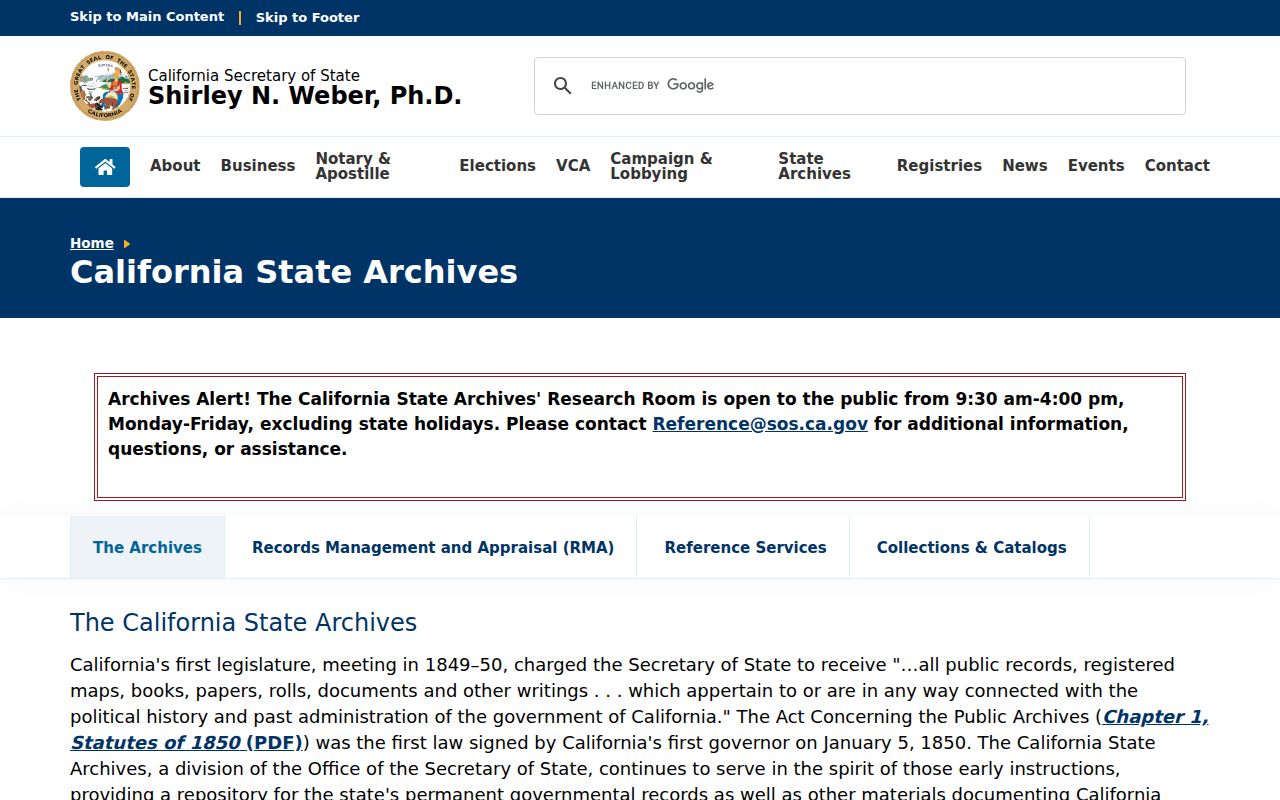
Use the State Archives catalog to identify a Chico-related collection before asking for a year or record group.
Households Behind Chico Previous Residents
Chico owners are only one layer of a house history. City directories, numerical street guides, census schedules, newspapers, and obituaries can show a dated Chico household or occupant connection that an ownership deed cannot. Pair Chico directory snapshots with released census years, then use Sanborn sheets to test the structure and newspapers to explain a move, death, business, or family relationship. A well-cited list of previous residents keeps each conclusion tied to its year and source.
Chico directory gaps, publication lag, changed names, and unreadable scans make exact move dates uncertain. A missing entry does not prove vacancy. A Chico permit does not prove a move. A deed does not prove that the grantee slept at the address. Write the conclusion at the strength the evidence supports.
Researching Chico previous residents is appropriate for house history, family history, genealogy, and personal curiosity. Living-person privacy still matters. Do not use a dated address trail to stalk, harass, intimidate, or expose a protected person.